
Screen printing is a widely used and well-established printing technique that entails several steps. It’s pretty adaptable, as it may be done on a variety of surfaces of various shapes and sizes. A traditional approach can be used to create this strategy. In many applications, Screen Printing Ink with Additives is also considered to enhance ink performance and achieve better results. Screen printing inks that are either available as one or two-component inks provide excellent color consistency and adhesion to various surfaces, making them suitable for a wide range of applications.
The Evolution of Screen Printing and Screen printing inks/paints/coatings
Screen printing is a centuries-old art form. Around 950 AD, an early form of the process was pioneered in China as a method of printing designs onto fabric. Several centuries later, Japanese artists used a stiff brush to force ink through a mesh screen woven from human hair to transfer designs onto paper and textiles.
Screen printing first appeared in Europe in the 18th century, but it was sluggish to gain popularity as a method of fabric printing due to the excessive expense of silk mesh at the time.
By the early twentieth century, printers had created photo-sensitized emulsions, allowing craftspeople to manufacture complicated stencil designs much more quickly.
Screen printing is now employed as both an artistic medium and a commercial printing method. Because a single stencil can be used to replicate the same pattern hundreds — if not thousands — of times, it’s an excellent method for generating huge printing impressions on the various substrates such as plastic, glass, leather, wood, garments, and many others.
How does Screen printing technology work ?
Screen printing is a type of direct printing that follows a set pattern. A blade and squeegee, a mesh (screen) made of synthetic polymers such as nylon and polyester is used to transfer the stenciled design onto the substrate and define the final image.
First, the printer prints the design on the final product onto a transparent acetate film. Then the printer will next select a mesh screen that is appropriate for the design’s intricacy and the substrate which is being printed.
He will print the design on the mesh and then the screen is placed on the printing press over the product that needs to be printed.
A squeegee is used to drag the ink along the whole screen length once it has been applied at the top end. After that, the printed object is dried, curing the ink and giving it a smooth, colorfast surface. Finally, before being passed on to its new owner, the completed product will be cleaned to eliminate any residue and properly examined.
Press for screen printing
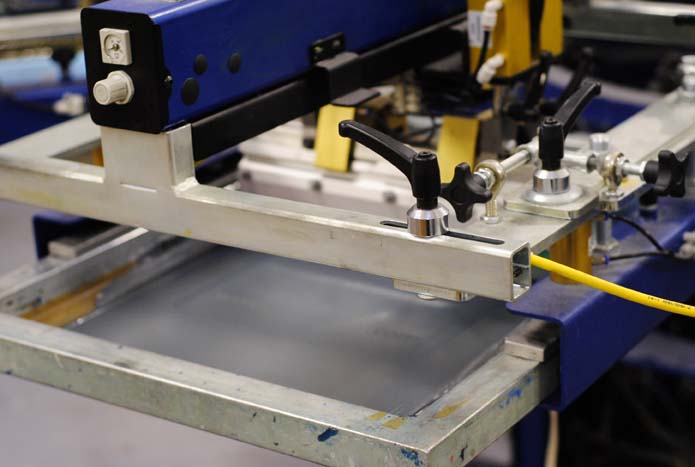
While screen printing may be done with simply a mesh screen and a squeegee, most printers prefer to utilize a press since it allows them to print many things quickly. As the press keeps the screen in place between prints, it’s easier for the user to change the paper or clothes being printed.
Screen for screen printing (Silkscreen)
In silkscreen printing, silkscreen is a metal or wooden frame with a thin mesh cloth stretched across it. Traditionally, this mesh was made up of silk thread, but polyester textiles have replaced it, providing the same performance at a cheaper cost. The mesh may be customized in thickness and thread count to match the surface or printed fabric texture with smaller gaps between threads allowing more detail in print.
Squeegee
A squeegee is a long wooden, metal, or plastic handle with a rubber blade attached. It is used to force the ink through the mesh screen onto the printed surface. The printer will generally choose a squeegee of the same size as the screen frame, providing excellent coverage.
The Pigments (Inks)
The ink, pigment, or paint is forced through the mesh screen on the product that leaves a colored imprint of the stencil pattern on the product.
Selecting the ink is much more than simply picking a color. Several special inks may be employed to provide various effects on the completed product.

Screen Printing Ink with Additives: Understanding Ink Composition
Pigments – They make up between 5% and 30% of ink. Typically, Pigments are finely shredded solid particles that are distributed in the binder rather than dissolved in it. In most cases, a larger concentration of a certain pigment influences the intensity of its color. In practice, however, optimum doses of pigments are employed, above which no change in color is noticeable.
Binders – comprises between 15% and 50% of the ink’s makeup Its purpose is to moist the pigment, allowing its particles to disperse more easily. The adhesive determines the printing characteristics of the ink as well as how it adheres to the substrate. These materials also provide appropriate gloss and wear resistance. As binders, several types of resins are often employed.
Additives – How Screen Printing Ink with Additives Improves Print Quality and Performance, it is unavoidable for printing employees to actively adapt to changing printing conditions, utilize good inks, and enhance printing quality. It is unavoidable to add several types of ink additives with distinct characteristics to the ink. Certain ink characteristics can be improved by using ink additives.
Types of Screen Printing Ink with Additives and Their Applications
– Solvent-based screen printing inks paints/coatings/color:
These screen printing inks are often not ready to use and require the addition of specific thinners, hardeners, or retarders. Solvent inks work well with a variety of surfaces and can meet higher opacity and performance requirements.
– Water-Based screen printing inks/ paints/ coatings/colors
To communicate the color pigment, water is used as a solvent basis in water-based ink. The water-based ink is then printed on a product during the screen-printing process. The product is subsequently put through a conveyor dryer, where the water evaporates, but the pigment remains. Spinks has a wide range of water-based screen printing inks.
– UV inks or UV curing inks/paints/coatings/colour:
Except for appropriate mixing before use, these inks are essentially ready to use. Some additives must be added in particular cases to get better outcomes on various substrates. It has a reduced footprint, faster throughput, and simple process management. UV inks appear to be the winner in display and graphics applications.
– UV LED curing Screen printing inks/paints/color:
LED curing inks are only appropriate for commercial use. This curing process differs from mercury light curing. One of the most used techniques currently, in which there is minimal heat, and hence no cooling is necessary, which might be helpful for particular substrates like polycarbonate. It is now mainly utilized in the Narrow Web business for curing UV inks. It has significant advantages over mercury light restoration. In contrast to traditional UV screen inks, UV LED inks can travel on high-speed screen printing equipment.
– Acrylic screen printing inks/paints/colors
Acrylic inks are a relatively new type of screen printing ink. They are gaining popularity alongside their water-based cousins. Acrylic inks provide a wide range of printing processes and unique effects. In addition, acrylic screen printing inks have the potential to dry naturally. This can be useful for printing on polyester fabric, which is notorious for having curing difficulties (dye migration, discoloration, and other concerns). Screen printers have long wanted high-quality air-drying inks.
On which substrate Screen-printing inks is applied?
By utilizing the stencil, screen printing may be used to imprint on a wide variety of flat and shaped surfaces of varied forms and sizes. Fabric and paper are the two most frequent substrates used on industrial grounds, although in the event of specialist inks, other base materials may be utilized. Such as
- Plastic
- Abs
- Acrylic
- Pom
- Cab
- Pvc
- Pc
- Thermosetting Plastic
- Pe / Pp
- Pre-Treated
- Ps
- Pu
- Primers And Coated Pieces
- Polyamide And Polymers Glass
- Glass
- Ceramics
- Textiles
- Metal
- Lacquered Substrates
- Rubber
- Wood
Screen printing inks drying techniques :
The inks are usually classified into categories based on their capacity to concentrate. In their most basic form, printing inks are liquids or extremely close to liquids. The process of changing from a liquid to a solid form is known as drying of the ink, and it can be accomplished physically, chemically, or a mix of both techniques. There are several forms of drying:
- Absorption drying- The ink dries when it travels through the surface fibers and is absorbed by the surface itself.
- Oxidation drying – The ink dries as a result of the oxygen absorption process from the environment. The gas reacts rapidly with resins, changing their mechanical state from liquid to solid.
- Evaporative drying – The evaporation rate of chosen solvents, as well as the affinity between the resins and the solvents employed, determine this form of drying.
- Chemical drying – In this type of drying is done using chemicals. These chemicals are used to keep the type of ink we are using and the surrounding condition. As chemicals react under predefined environments.
- Radiation-induced drying – under this drying is done using different types of radiation such as ultraviolet radiation (UV ), infrared.
What Makes Spinks World a Reliable Partner?
At Spinks World, we believe that providing excellent products isn’t enough; our consumers want much more. They look forward to our expertise of over 30 years, our out-of-the-box printing solutions backed by excellent after-sales service.
Our material safety officer guarantees that all of our inks meet industry standards. Not only in terms of legal requirements, but also in terms of our client’s high expectations and the standards we set for ourselves.
contact our product safety manager: psm@spinksworld.com
Implementation and Innovation Capabilities
Our ongoing research and development efforts have resulted in providing screen printing inks for various complex substrates. As a result, we offer a diverse product range to meet our clients’ different and varied demands.
- Standards and eco-friendly: That is why we believe in Compliant inks
Spinks World has always been concerned with the welfare of humans and the environment. We have demonstrated our commitment to product and environmental safety by establishing a dedicated department. As a result, we have steadily reduced the use of harmful chemicals.
- Printing inks Supply system: All over the world
Spinks World understands that interrupted inks supply equals lost production and revenues. Our supply system and skilled team help customers in minimizing disruption to their processes with uninterrupted supplies.
- Quality Management: NO compromise with inks quality and adhesion
We realize that strict quality control is required to provide consistently dependable goods and services. We see everything through from start to end, beginning with the acquisition of raw materials and ending with delivering the required result to you.
Tailor made inks solutions
Spinks World believes in adaptability and tailored solutions for each individual. Because of this strategic advantage, we are able to develop bespoke ink formulas for our customers, regardless of volume. Our R&D team will optimize the formulation to satisfy all of the specifications specified by the clients. Spinks World provides more than just ink and paints mixing and blending.
The production of inks and paints necessitates a wide range of processes, including grinding. grinding of tiny media and dispersion We offer a full solution for your inks and paints needs. Our innovative approach ensures superior quality while minimizing investment.
Screen printing inks Colour matching system makes us the only one in the market
How can you precisely mix and match the identical colors according to the customer’s requirements, needs a thorough response?
We have a staff of highly qualified and experienced specialists that know how to match colors precisely by spectrophotometers that are highly efficient in quality control and consistency giving confidence to the supplier of the inks, saving on time and money. Our ink database includes all basic colors and formulations according to Pantone®, HKS®, and RAL®.
Screen Printing Solutions for various industries
Decoration of Glass with screen printing inks
“Using Ink and Glass to Create Beautiful Designs”
Screen printing on glass produces impressive results. However, because of the non-porous surface of the glass, high surface tension, and difficulties with static electricity, it needs an acceptable degree of skill. For instance, suppose the glass type, ink type, curing process of the inks in use, adhesion requirements, ambient conditions, print method, and precise ink formulation are understood. In that case, all of these issues may be readily resolved.
When we talk about printing on glass, whether flat or shaped, the possibilities are endless. Manufacturers must create their products to make a statement. With its experience of more than 30 years, Spinks World is helping manufacturers provide organic inks for glass.
We have an endless range of colors and shades to print on glass bottles, furniture, mobile screens, containers, and many more. However, printing on this difficult medium needs proper skills and experience which is hands-on with Spinks technical teams.

Our glass screen-printing range has
- Two-component ink, Solvent-based ink, LED-curable, One-component baking ink UV-curable inks,
- High gloss inks
- Excellent temperature and outdoor resistance inks
- Cost-effectiveness
- Unmatched resistance to water and steam
- BPA free
- Chemical residence
- Excellent adhesion
How screen printing inks has helped the PACKAGING industry ?
Direct printing on bottles composed of PE, PP, PET, and other plastics opens up a world of possibilities and problems. Customized designs offer a one-of-a-kind, separate statement and allow items to stand out. The best approach is screen-printing.
Packaging for plastic products, namely bottles and tubes, is available in various forms and sizes. Furthermore, the substrate, its color, and the required degree of flexibility can all vary significantly. In terms of characteristics and look, inks must match rising demands and growing expectations.
Our screen-printing ink range for packaging is.
- UV-curable, LED-curable
- High-gloss
- Verified low migration characteristics
- Adaptable for usage on a variety of forms
- Safe to use for exterior food container printing.
- Exceptional adhesive properties
- Suited for use with a high-speed printing machine
- Usable for Direct printing on containers
- Unmatched resistance to water and steam.
- Dries fast
- Maximum opacity.

Screen printing inks and paints for LABELS
Create an Eye-Catching Brand Recognition
Many items now feature a one-of-a-kind printed label. These range from a clear no-label appearance to conspicuous labels for high-end products. Message-giving, durable, and appealing designs are really important for luxury items. Screen printing is the best way to accomplish these results. The screen printing process has high opacity, which is useful for dark substrates, appealing outcomes with a choice of high-gloss or matte finishes, and outstanding resistance to packing contents as well as mechanical strain.

Our screen-printing ink range for Labels is.
- UV-curable
- High-gloss
- Verified low migration characteristics
- Adaptable for usage on a variety of forms
- Safe to use for exterior food container printing.
- Exceptional adhesive properties
- Suited for use with a Rotary screen printing
- Usable on various substrates
- Unmatched resistance to water and steam.
- Dries fast and with maximum opacity.
SCREEN PRINTING COLOURS FOR OPERATOR CONTROL PANELS (OCP) / PLASTIC
Electronic buttons and controllers must be dependable, simple to operate, and resistant to dust and weather. Spinks World not only sells OCP-specific inks, but it also sells a variety of other inks for various switches and control panels. We are one of the few professionals that can provide end-to-end support. With our considerable expertise as an ink provider and our in-depth understanding of substrate and techniques, we are the leader in providing cutting-edge innovations.
Our screen-printing ink range for (OCP) / PLASTIC is.
- Solvent-based,
- Does not block the screen
- Highly flexible
- UV-curable
- High-gloss ink
- Speedy drying
- High opacity
Screen printing applications on operator control panel Glass
Bringing a Personalized Experience
Touch panels are rapidly replacing panel switches in many items. They are quite appealing because of the mix of modern, elegant Glass and electrical capabilities, as well as very robust and dirt-repellent surfaces. In light of this, Spinks World has created specialized, very opaque inks for applications such as smartphones and tablets.
Applications of our glass OCP inks
- Mobile
- Tablets
- Computers
- Television screens
- Other white goods panels
And many other products with touch screen/touch panel
Our screen-printing ink range for (OCP) / Glass is.
- Unmatched results on glass panels
- Solvent-based,
- does not block the screen
- Highly flexible
- UV-curable
- High-gloss ink
Screen Printing Paints & spray coatings for AUTOMOTIVE parts
Attractive and premium
Consumers are extremely choosy when it comes to purchasing a car –especially with regard to its looks. Screen printing, with its vibrant colors and flexibility, is essential in the automobile sector. When it comes to printing on various components of automotive, screen printing provides unmatched results from printing a small component to a large part screen printing has unmatched results and application for the automotive sector. These inks need to stick on the product irrespective of atmosphere, dirt, and cleaning agents used to clean cars. Spinks World ink systems produce impressive results anywhere they are utilized. Our inks meet a wide range of today’s automobile screen printing needs for first-rate look and quality, as well as a variety of colors
Our screen-printing ink range for the Automotive industry is.
- Solvent-based
- Highly flexible ink
- Chemical- resistant
- Economical
- Two-component ink
- No yellowing or fading
- UV-curable ink
- Temperature-resistant
- Excellent adhesion

Screen printing inks applications on household device & electrical equipments
Made for Day-to-Day Rough handling
Instruction and other marks are necessary on any electrical and household appliance, whether it is a washing machine, refrigerator, Air conditioner, and audio-video device. Our screen printing inks provide outstanding resilience to a wide range of surfaces. The colorful prints play an essential part in alluring these electrical and electronic products. Typically, these components are formed of
- Polycarbonate
- Acrylic
- Glass
- Metals

Our inks for ELECTRICAL DEVICES AND HOUSEHOLD APPLIANCES is
- Chemical resistant
- Stain-resistant
- Dirt-resistant
- Solvent-based
- Two-component
- Cleaning agents resistant
- Electrical resistance
- Durable
- Opaque
How screen printing ink are useful in Backpacks and Umbrella industry?
To print on umbrellas and backpacks, screen printing is a more often utilized technique. It is highly cost-effective and may be used for large manufacturing. Spinks offers inks that are bright and opaque, making them ideal for printing on umbrellas and backpacks. In addition to conventional inks, we provide reflecting inks, luminous inks, and rainbow color inks for your printing needs. Our inks meet the majority of printing and industrial requirements and have a robust sticky property.
Our screen-printing inks range for Backpacks and Umbrella is
- Durable
- Opaque
- Stain-resistant
- Dirt-resistant
Screen printing solvent based inks usage and printing on Caps/ Closures
Solution for Screen printing on plastic and metal caps is a process that uses silk screens to imprint a pattern with extremely opaque inks onto the surface of the Closure. The result is a very glossy imprint that can be felt with the touch, giving the beverage cap a beautiful appearance. Spinks produce bright and opaque inks that are perfect for printing on Closure and hats. Our inks are very sticky and satisfy the majority of printing and industrial requirements. Additionally, it is capable of high-speed printing.
Screen printing inks for Plastics
It is critical to know the specific type of plastic when decorating or printing on a plastic substrate in order to plan for and prepare for any blockages. Ink formulas for a range of polymers are available in the market. Spinks provides Screen printing inks for various types of plastics.
Such as
- Polypropylene (PP)
- Polycarbonate (PC)
- Polyethylene terephthalate (PET)
- Polystyrene (PS)
- Polyvinyl chloride (PVC)

What are SPECIAL-EFFECT Printing inks and paints? Please list them down
Colors have a significant influence in our life. As these special-effect inks provide a memorable result, Spinks World has various types of special effect haptic screen printing inks
such as
- Metallic effects
- High-gloss metallic
- Mirror inks
- Glitter effects
- Pearlescent effects
- Glow-in-the-dark inks
- fluorescent inks
- Thermochromic effects
- Matt
- Structured
- Gloss effects
- Writeable inks
- Braille effect


